
Regulation
B2B e-invoicing: what Royal Decree 238/2026 requires
Electronic invoicing between companies and professionals will be mandatory in Spain under the Crea y Crece Law and Royal Decree 238/2026. Following Order HAC/1028/2026, it applies from 6 October 2027 to businesses invoicing more than 8 million euros and from 6 October 2028 to the rest.
- Author
- UserIT
- Published
- Updated
- Reading time
- 5 min

Sending a PDF invoice by email will no longer be enough between companies. The Crea y Crece Law requires invoices between businesses and professionals to be issued in a structured electronic format, and Royal Decree 238/2026 has already set out how. The obligation covers all companies and the self-employed, with different dates depending on their turnover.
What mandatory e-invoicing is
It is the obligation to issue, send and receive invoices between businesses and professionals in a structured electronic format that a program can read without human intervention. It is established by Law 18/2022, on the creation and growth of companies, known as the Crea y Crece Law, and implemented by Royal Decree 238/2026, of 25 March.
For these purposes, a PDF sent by email does not count as an electronic invoice, because whoever receives it has to type the data in again. With a structured format, the invoice goes straight into the customer’s management program.
When it becomes mandatory
Royal Decree 238/2026 came into force on 20 April 2026, but the obligation applies in phases from the ministerial order that regulates the Tax Agency’s public solution: twelve months later for businesses with a turnover above eight million euros a year and twenty-four months later for the rest.
Order HAC/1028/2026, of 2 October, which regulates that solution, was published in the BOE on 5 October 2026 and came into force on the 6th. The periods run from that date:
| Companies | Obligation | From |
|---|---|---|
| Annual turnover above 8 million euros | E-invoicing and invoice and payment statuses | 6 October 2027 |
| Other companies and professionals | E-invoicing; companies also report statuses | 6 October 2028 |
| Self-employed and income attribution entities with 8 million or less | Invoice and payment statuses | 6 October 2029 |
Which formats are accepted
Invoices must follow the European standard EN 16931 in one of its accepted syntaxes: UBL, CII, EDIFACT or Facturae. They can be exchanged through private e-invoicing platforms or through the free public solution of the Tax Agency, which will also act as a repository of invoices.
If you already exchange invoices by EDI with large retailers, you are part of the way there. What remains is to extend that structured exchange to the rest of your customers and suppliers, including the smallest ones.
Invoice statuses: acceptance, rejection and payment
What changes most in day-to-day work is that you will have to report the status of each invoice: whether it is commercially accepted or rejected and when it is paid in full, with the actual payment date. The deadline to report it is four working days, and full payment must also reach the public solution.
The rule aims to reduce late payment: with payment statuses on record, it will be possible to know which companies pay their suppliers late. For your administration team, that means recording every collection and every payment in the management program, invoice by invoice.
Which companies are obliged
All businesses and professionals are obliged in their transactions with other businesses and professionals, whatever their size. Annual turnover only decides the start date. Invoices to consumers and to public administrations follow their own rules; with the public administration, e-invoicing has been mandatory since 2015.
The self-employed and micro-companies will have the longest period, but they are also obliged. Anyone who invoices today with a spreadsheet or a word processor will have to move to a program that generates structured invoices.
How to prepare
Check whether your management program generates invoices in one of the accepted formats, whether it can send and receive them through a platform or through the public solution and whether it records the acceptance and payment of each one. Also tidy up the tax data of customers and suppliers and think about how you will receive purchase invoices.
Before your date, check these points:
- Your program generates the invoice in a valid structured format.
- Supplier invoices enter your system without typing them in.
- Acceptance, rejection and payment are reported within the deadline.
- Every customer and every supplier has the correct tax ID and address.
- It is decided who approves, who rejects and who records each payment.
E-invoicing, VeriFactu and SII
They are three different obligations. E-invoicing regulates the format in which invoices are exchanged between companies. VeriFactu regulates how the program that issues them records them and what the Tax Agency receives. The SII is the almost immediate submission of the VAT books that large companies, among others, already make. A company can have several.
On VeriFactu, see our guide VeriFactu and its dates after the postponement to 2027. And if you are not yet sure which program you need, start with how to choose an ERP.
How W3ERP handles it
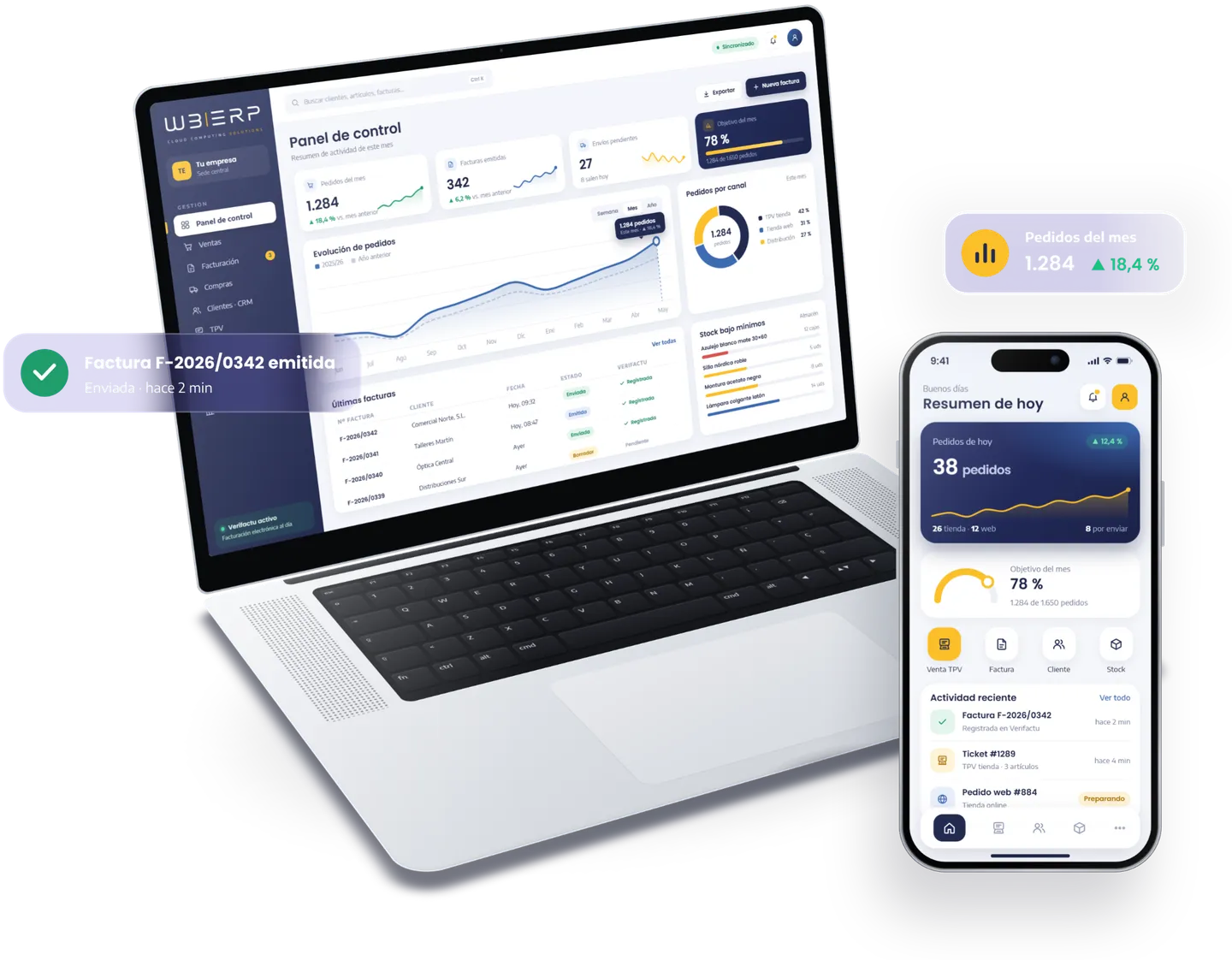
W3ERP includes in its sales and finance core the issuing and receipt of e-invoices, the SII, EDI with customers and suppliers and the tax module. If you want to review how your company will meet the mandatory e-invoicing timetable, tell us how you invoice today and we will explain the steps.
Sources
The facts in this article come from the sources below. Next to each one you will find who publishes it and the day we consulted it. When a source changes, we review the article and update its date; if you spot something out of date, write to us and we will correct it.
- Royal Decree 238/2026, of 25 March · Spanish Official State Gazette (BOE), accessed on
- Mandatory electronic invoicing · Spanish Tax Agency, accessed on
- Order HAC/1028/2026, of 2 October · Spanish Official State Gazette (BOE), accessed on
- Order on the public e-invoicing solution · Spanish Tax Agency, accessed on